




- Relieving Toothache
- We help preserve teeth even with severe inflammation
- We treat root canals to prevent inflammation from returning
- We restore teeth after treatment to ensure long-lasting service

Pulpitis Treatment
Pulpitis is an inflammation of the tissue inside the dental canals.
Pulpitis is one of the most common dental diseases. It is most often caused by untreated caries, which allows the infection to reach the pulp and cause inflammation.
The main symptom of pulpitis is spontaneous acute pain
Pain is usually sharp, acute, and stabbing, but can also subside and return in bouts.
Pulpitis treatment is a sequential solution to two problems:
- Eliminate inflammation and prevent its recurrence.
- Strengthen the tooth and restore its precise shape and aesthetics
Immediate consultation is required, otherwise the risk of tooth loss increases dramatically.
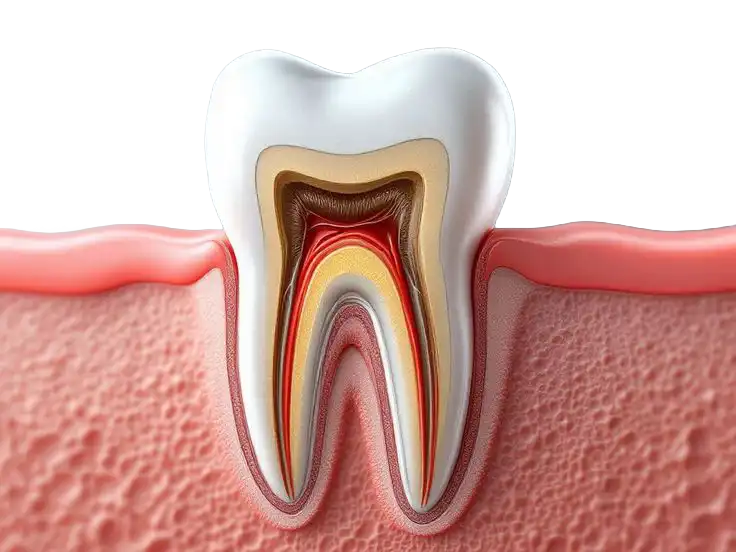
How pulpitis is treated at RoyalDent
We offer comprehensive, turnkey treatment: we don't just remove the nerve and fill the canals, but fully restore the tooth's functionality.

Accurate diagnosis and examination
Treatment begins with an examination and diagnosis. To assess root anatomy and the number of canals accurately, we use periapical radiographs and, when necessary, CBCT. This is especially important for multirooted teeth with complex anatomy.
We individually select a safe anesthetic to ensure your peace of mind and comfort. Therefore, pulpitis treatment under anesthesia is completely painless.

Root canal treatment and cleaning
After removing carious tissue and creating access, the dentist removes the inflamed pulp and begins root canal treatment.
We use:
- endodontic instruments with an apex locator - for accurate determination of root canal length;
- Ultrasound - for cleaning hard-to-reach areas;
- Antiseptic treatment of each root canal.
Each stage is radiographically monitored to prevent errors and recurrence of inflammation.

Root Canal Filling
After cleaning, the canals are sealed. This prevents reinfection and creates a reliable foundation for further tooth restoration.
At this stage, endodontic treatment is complete, but the work on the tooth is not.

Periodontitis Treatment
Periodontitis is an inflammation of the soft tissues surrounding the tooth and supporting it in the jaw.
Currently, periodontitis is one of the most common inflammatory diseases of the root and surrounding tissues. It occurs due to the development of an infection in the root canal. While enamel or dentin damage can be easily detected with the naked eye, periodontitis can be difficult to diagnose without consulting a dentist: it can progress even without a deep carious or pulpitis cavity, remaining in a chronic stage.
Microorganisms can enter the root canal as a result of untreated caries, a crack with a breach or chip, previous poor-quality nerve removal and root canal filling, or trauma. If you experience pain when eating, biting, or a nagging pain, you should immediately consult a specialist: it is crucial to detect the disease in its early stages, as delayed treatment can lead to tooth loss.
Based on the site of infection, periodontitis is divided into apical, which affects the area around the root and is more common, and marginal, which initially occurs in the gum area and is less common. Apical periodontitis usually develops due to the waste products of microorganisms found in the root canals; marginal periodontitis is more often caused by trauma.
Immediate consultation is required, otherwise the risk of tooth loss increases dramatically.

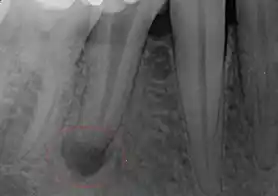
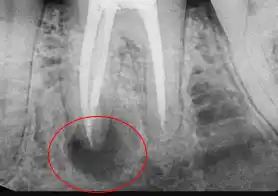
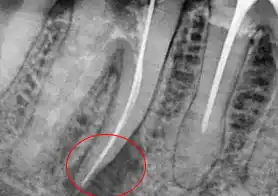
Indications for periodontitis treatment
Periodontitis treatment is performed when the inflammatory process develops beyond the tooth root and affects surrounding tissues. The physician's goal is to eliminate the source of infection, relieve pain, and prevent complications.
- Acute Periodontitis
This is accompanied by severe pain when biting, a sensation of a tooth "growing," and gum swelling. In this situation, treatment is aimed at reducing inflammation, eliminating infection, and preventing its spread. - Chronic periodontitis
A fibrous, granulating, or granulomatous process, which often occurs without obvious symptoms and is visible on X-rays. Although painless, the inflammatory focus at the root apex gradually destroys bone tissue and can lead to the formation of a cyst. Treatment allows the source of infection to be eliminated and the tooth to be saved. - Exacerbation of a chronic condition
With weakened immunity or increased tooth strain, chronic periodontitis can worsen, causing pain, swelling, and discomfort. In this case, treatment is aimed at stopping the exacerbation and subsequently resolving the inflammation.
Contraindications to periodontitis treatment
In some situations, endodontic treatment of periodontitis is inappropriate or requires prior preparation.
- It's not advisable to save the tooth
If a tooth is damaged below the gum line, exhibits grade III mobility due to bone loss, or has significant tissue damage that makes restoration impossible, the prognosis is unfavorable. In such cases, the doctor recommends extraction followed by prosthetics or implantation. - Root canal obstruction
With complex anatomy, curvature, or severe calcification of the canals, making it impossible to properly treat and seal them hermetically, the effectiveness of periodontitis treatment is significantly reduced. Treatment strategies are determined on an individual basis.
When a Tooth Does Have to Be Extracted
Sometimes, despite all modern treatment methods, saving a tooth proves impossible or impractical. This doesn't mean the treatment is "failed"—in some situations, extraction is the most sensible and predictable solution.
The dentist may recommend tooth extraction if:
- the tooth is so damaged that it cannot be reliably restored;
- a crack or root fracture has been detected, in which case the inflammation will constantly recur;
- the inflammatory focus continues to destroy bone tissue despite treatment;
- Preserving the tooth creates a risk of complications for adjacent teeth and bone tissue.
In such cases, we discuss alternatives in advance—implantation or prosthetics—to ensure restoration of the dentition without loss of function or aesthetics.
Prices for root canal treatment in Jūrmala
- Anesthesia30 €
- Root canal treatment for 1 crown400 €
We clean and fill 1 root canal. Tooth restoration is not included in the price.
- 2-Root Canal Treatment600 €
We clean and fill 2 root canals. Tooth restoration is not included in the price.
- 3-Root Canal Treatment800 €
We clean and fill 3 root canals. Tooth restoration is not included in the price.
- 4-Root Canal Treatment1000 €
We clean and fill 4 root canals. Tooth restoration is not included in the price.
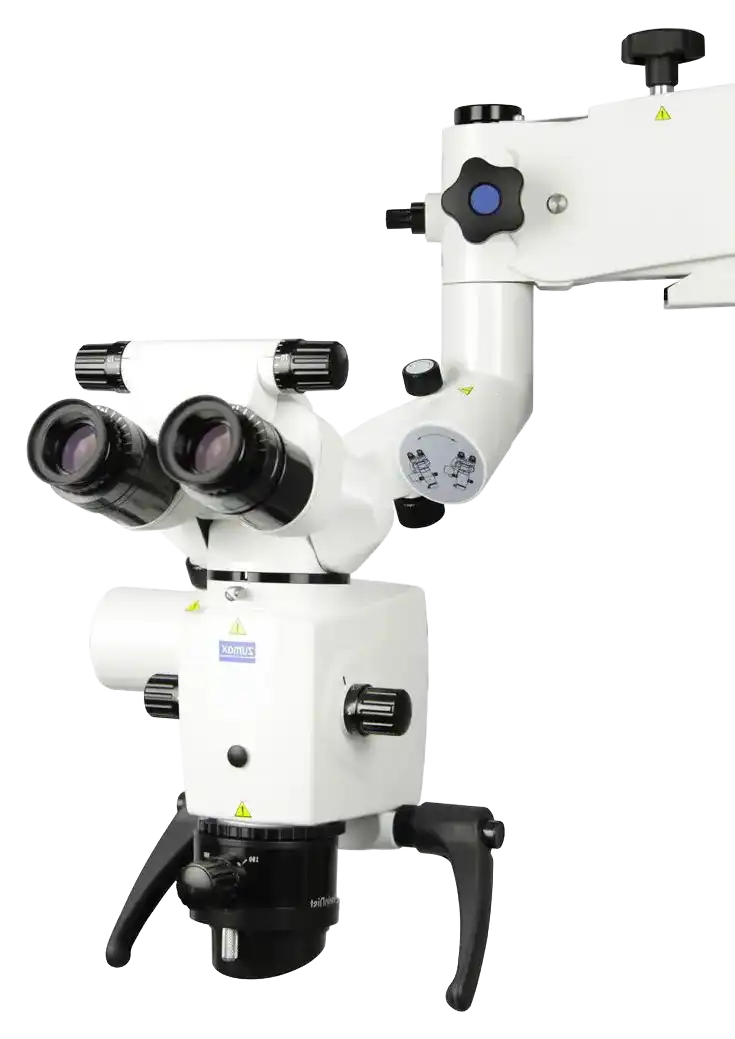
- Using a microscope (30 minutes)35 €
Microscopic root canal treatment in complex cases
- Using a microscope (60 minutes)70 €
Microscopic root canal treatment in complex cases
- Zirconium Dioxide Crown750 €
Modern aesthetics and durability: zirconium completely imitates a natural tooth
- Tooth restoration with a fillingот 100 €
Restoring a tooth after root canal treatment
Our Specialists








Daniela Rožinska
Assistant
Vladislavs Dvurečenskis
Assistant

Edita Čeme
Administrator

Tatjana Černogorceva
Administrator
Answers to frequently asked questions
We've collected what patients ask most frequently. Didn't find the answer?
No. Treatment is performed under modern anesthesia and is painless.